Squat Calculator
Want to know your squat max without attempting a true one-rep max? Simply enter the weight lifted and the number of reps completed. This squat calculator—also known as a squat max calculator—estimates your one-rep max (1RM) and displays training weights.
Results by formula
| Formula | Estimated 1RM |
|---|
Training percentages
Based on the 1RM shown above. Rep ranges are typical guides, not fixed rules.
| % of 1RM | Weight | Typical reps |
|---|
Training plan from your 1RM
Pick a goal to see the sets, reps and working weights that fit your max.
How to use this squat calculator
- Enter the weight you lifted and the number of reps you completed.
- Choose a formula, or leave it on Epley.
- Read your estimated squat max, then use the percentage table and training plan below it.
Why I built this squat calculator
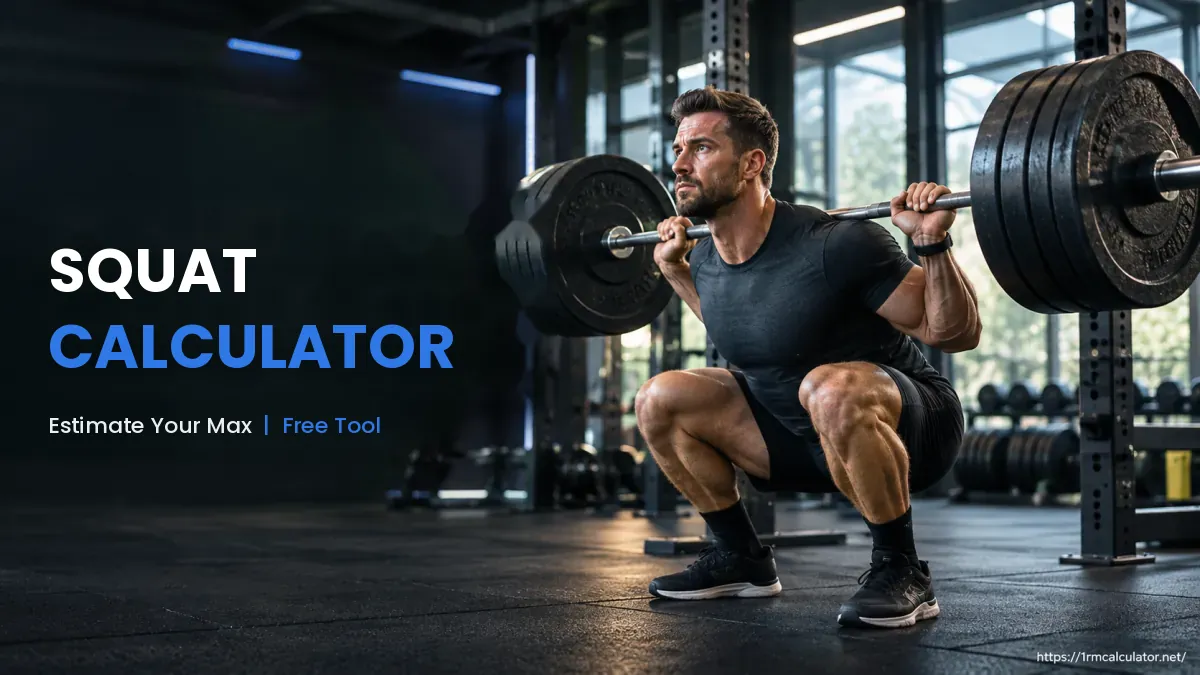
The squat is often called the king of exercises, yet at the gym I regularly see people load far too much weight just to impress others, cutting depth and letting their form slip. After 4 to 5 years of lifting, I built this tool to help lifters estimate their squat 1RM from lighter sets, with much lower risk than testing a true max. Treat the number as an estimate, and always squat inside a rack with safety bars.
How to test your squat max safely
The squat is one of the hardest lifts to test safely, because a failed rep can trap you under the bar. A lighter set gives you a useful estimate with much lower risk. For the most reliable result:
- Set the safety bars or pins just below your lowest squat depth, or squat inside a power rack.
- Warm up with the empty bar, then add weight in small steps.
- Pick a weight you can squat 3 to 6 times and stop when you cannot do another rep to your normal depth.
- Enter the weight and reps above.
Keep the same depth, bar position and stance every time you retest. A set that gets shallower as you get tired is not comparable with a full depth set.
Which formula should you use for squat?
Epley is the default here because it is one of the most widely used. You can switch to any of the other six formulas, or to the average of all seven.
For example, a set of 100 kg for 5 reps gives about 116.7 kg with Epley, 112.5 kg with Brzycki, 119 kg with Mayhew, and an average of 115.5 kg. They are close, but not identical. Choose one formula and keep using it so your progress is easy to compare.
Using your squat 1RM in training
Once you have your number, the percentage table and training plan above give you working weights. As a guide:
- Strength: 85 to 95% of your 1RM, for 1 to 5 reps.
- Muscle size: 65 to 80%, for 6 to 12 reps.
- Endurance: 50 to 65%, for 12 to 20 reps.
With the Epley result above, 85% is about 99.2 kg, a good weight for sets of 5 or 6.
Why your squat estimate may be off
- Cutting depth as the set gets harder makes the number too high.
- Sets of more than 10 reps are less accurate.
- Poor sleep, a heavy deadlift day or leg day soreness can lower your performance.
- High bar and low bar squats are different lifts for most people. Track them separately.
- Squatting with a belt, knee sleeves or wraps changes the number. Test the same way each time.
Squat 1RM FAQ
How many reps should I use?
A hard set of 3 to 6 reps taken close to failure gives the most reliable estimate. Above 10 reps the result becomes less accurate.
Does depth change my squat max?
Yes. A squat to parallel or below is a different weight than a partial squat. Use the same depth every time and only count reps you would be happy with.
Can I use this for front squats?
Yes, but track front squat and back squat separately. Do not compare the two numbers.
How often should I retest?
Every 4 to 8 weeks is enough. Update your training weights each time.
Should I test my true squat 1RM?
Only if you are experienced and you squat in a power rack with safety bars or have spotters. For most lifters an estimate from a lighter set is safer and almost as useful.
Why does another calculator show a different number?
Different sites use different formulas. Switch the formula above to compare, or choose the average.
Looking for a specific lift? Try our Bench Press Calculator, Deadlift Calculator or the main 1RM calculator.